



Last reviewed: May 2026
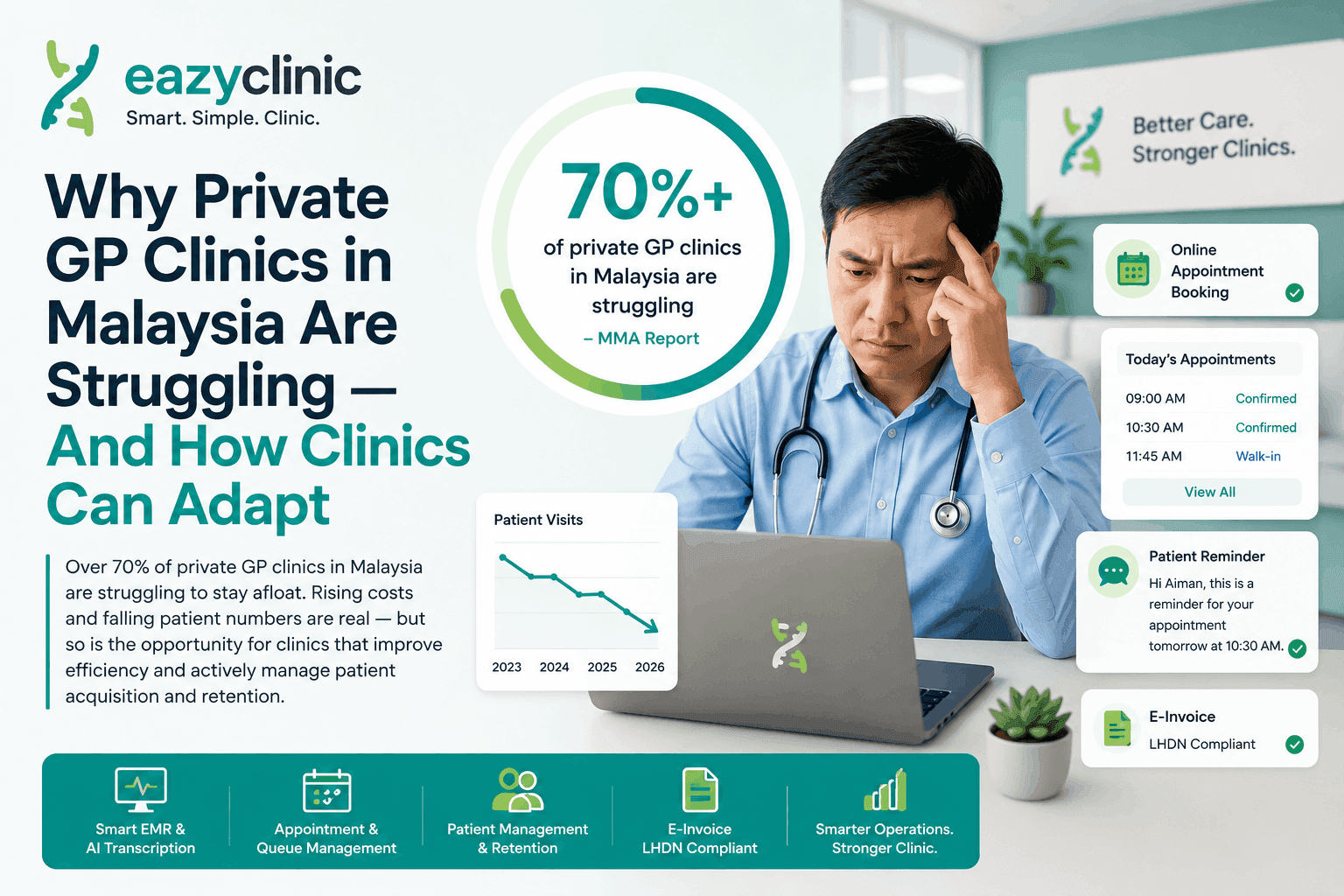
A report published this week by the Malaysian Medical Association (MMA) confirmed what many clinic owners already feel day to day: more than 70% of the country's 10,000 private GP clinics are struggling to stay afloat. The New Straits Times covered the story in full — rising operating costs, an influx of new general practitioners entering the market, and a decline in patient numbers are squeezing private clinics from every direction at once.
This article looks at what is actually driving these pressures, where the real opportunity for adaptation lies, and what practical steps clinics can take to build a more sustainable practice.
"We were seeing the same number of patients each day but somehow always felt behind. The problem wasn't the number of patients — it was how much time we were losing to manual work in between each one."
— Dr. Amirul, GP Clinic Owner, Petaling Jaya
Understanding the Pressure on Private Clinics
Three forces are converging at the same time for most private GP clinics in Malaysia.
Rising operating costs — rent, salaries, medical supplies, and compliance requirements have all increased steadily. Unlike many businesses, a clinic's ability to raise prices is constrained by patient expectations, market competition, and panel agreements.
More GPs, same patient pool — the number of private GPs in Malaysia has grown significantly, while the population of self-paying patients has not grown at the same pace. More clinics are competing for the same patients, which means the clinic down the street is now a real competitive threat.
Patients who expect more — patients today choose clinics differently than they did five years ago. They search online, check availability, read reviews, and often book before they visit. Clinics that are difficult to find online or inconvenient to access lose patients before a single consultation takes place.
Efficiency Is No Longer Optional
Many clinics respond to financial pressure by trying to see more patients each day. But seeing more patients through an inefficient system rarely improves the situation — it often just creates more stress for staff and a worse experience for patients.
The clinics that are navigating this period well are treating operations as seriously as clinical care. That means identifying where time is being lost, removing manual steps that staff should not be handling, and using the right tools to reduce the administrative burden on everyone in the clinic.
Common areas where clinics lose significant time include manual patient registration, billing that is calculated and typed up by hand, documentation that is written from scratch for every patient, and inventory that is tracked using spreadsheets or physical records.
Removing these inefficiencies does not require hiring more staff. It requires the right systems. When administrative time is reduced, staff can focus on patient-facing work, consultations run more smoothly, and the clinic can handle more patients without increasing headcount.
EazyClinic's AI consultation transcription captures clinical notes automatically as the doctor speaks, removing the need to write or type the same information twice. Combined with one-click billing, one-click MC and document, and digital patient records, clinics can cut daily administrative time significantly without changing the number of staff on shift.
Patient Acquisition and Retention: The Lever Most Clinics Are Not Using
Operational efficiency helps clinics do more with what they have. But the bigger opportunity for revenue growth lies in how clinics acquire and retain patients.
With more GPs competing for fewer self-paying patients, waiting for walk-ins is not a stable strategy. The way patients decide where to go for care has changed fundamentally — and for many clinics, it is happening in a way they cannot see.
Before a patient ever visits a clinic, they commonly do the following:
- Search online for a GP near them
- Check if the clinic has a page with clear information, operating hours, and services
- Look for reviews or patient feedback
- See whether they can book an appointment in advance
If a clinic is difficult to find online, has no booking option, or provides little information, the patient moves on to the next result. This happens without the clinic ever knowing it lost a potential patient.
Visibility and ease of access are now patient acquisition tools. Clinics that have a clear online presence, easy booking, and good communication convert more of those searches into actual visits.
Building a Patient Acquisition and Retention System
Acquiring a patient is only the first step. Retention — getting that patient to return for their next consultation, and to recommend the clinic to others — is where sustainable revenue is built.
A patient who visits once and does not return is a missed opportunity. A patient who returns consistently, receives reminders when they are due for a follow-up, and finds the booking process easy each time is a long-term revenue contributor.
The difference between these two outcomes is often determined by how well the clinic manages its patient relationships — not by clinical quality alone.
1. Make Your Clinic Easy to Find and Understand
Patients searching for a GP online should be able to find your clinic quickly and get the information they need in one place — location, operating hours, services, and how to book.
EazyClinic automatically generates a public clinic page for every clinic the moment they sign up. This page displays clinic details, doctor profiles, services, and a live booking link. There is no web developer required and no separate website to maintain. When a patient searches for a GP in your area, your clinic can appear with complete, accurate information.
2. Allow Patients to Book Without Calling
One of the most common reasons patients choose a competitor clinic is convenience. If booking requires a phone call during clinic hours, many patients will simply go to a clinic that lets them book online at any time.
Online appointment booking allows patients to see available slots and confirm an appointment directly — without back-and-forth communication. For the clinic, this reduces front-desk call volume and manual scheduling effort. For the patient, it removes a friction point that might otherwise lead them to choose a different provider.
3. Reduce Wait Times and Manage Queue Expectations
Long or unpredictable waiting times are a significant reason patients do not return. When patients arrive and have no visibility into how long they will wait, their experience becomes stressful before the consultation even begins.
Queue and appointment management gives both staff and patients a clearer picture of the clinic's flow. Booked appointments and walk-ins are managed within a single view, and staff can communicate estimated wait times accurately. This improves the in-clinic experience and directly supports patient retention.
4. Communicate with Patients Before and After Their Visit
Patients who receive appointment reminders are significantly less likely to miss their visit. Patients who receive relevant follow-up communication are more likely to return and to feel that the clinic is invested in their ongoing care.
Consistent communication — even simple appointment confirmations — builds the relationship between a patient and a clinic over time. This is what separates clinics that grow through patient loyalty from clinics that depend entirely on new walk-ins each day.
Staying Compliant Without the Administrative Overhead
Beyond operations and patient management, Malaysian clinics also face compliance requirements that add to the administrative burden. LHDN e-invoice is now a regulatory requirement, and managing it manually or through a separate system adds unnecessary cost and complexity.
LHDN e-invoice is included in every EazyClinic plan — not as an add-on. Clinics do not need a separate system or additional subscription to stay compliant.
Transparent Pricing for Clinics Watching Costs
For clinics under financial pressure, software should not add to the uncertainty. EazyClinic publishes all pricing publicly at eazyclinic.io/pricing — no demo required to understand what you will pay.
-
Basic — RM 148/month. Includes EMR, AI transcription, billing, pharmacy and inventory management and LHDN e-invoice.
-
Growth — RM 209/month. Everything in Basic, plus appointment scheduling, queue management auto-generated public clinic page with online booking link.
There are no hidden tiers and no features locked behind a sales conversation.
Conclusion
The MMA's findings reflect real structural pressure in the Malaysian private clinic market. Rising costs and more competition are not going away. But for clinics that treat this as a reason to adapt — rather than simply endure — there is a meaningful opportunity.
Clinics that reduce operational waste, build a clear online presence, and actively manage patient acquisition and retention are in a stronger position than those relying on the same approach they used five years ago.
EazyClinic is designed to support this transition: a single clinic management system covering daily clinic operations, patient-facing visibility, appointment booking, and compliance — without requiring separate tools or a large upfront investment.
Clinics looking to evaluate their options can explore EazyClinic's features or view transparent pricing to understand what is included at each plan level.
![[object Object] icon](/_next/static/media/whatsapp-logo.faecda2e.svg)