



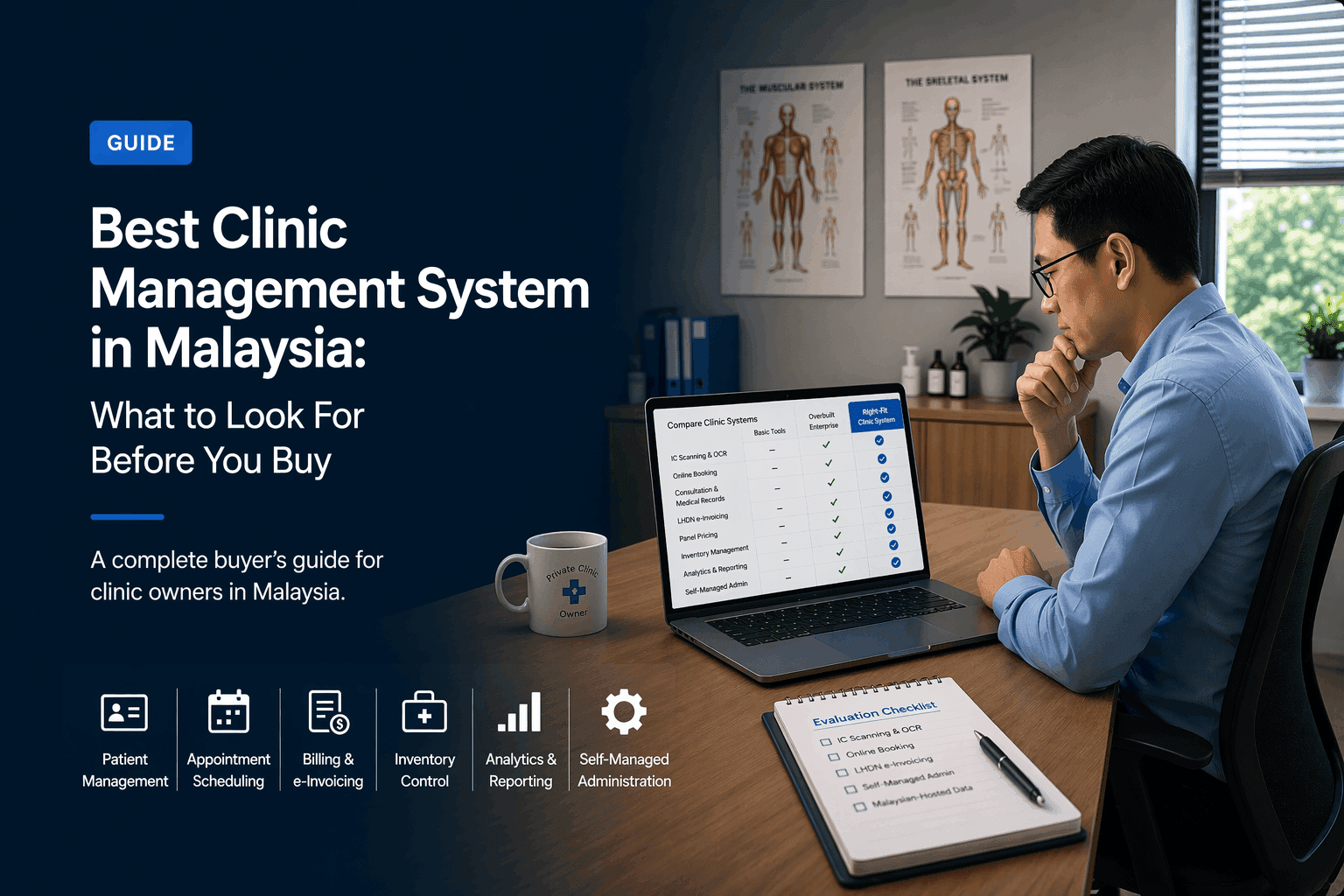
Best Clinic Management System in Malaysia (2026): What to Look For Before You Buy
TL;DR: Most clinic owners evaluate software based on demo impressions and pricing. The clinics that make the right choice evaluate based on seven specific features — and ask five questions that vendors rarely volunteer answers to. This buyer's guide covers both.
Last reviewed: August 2026
Table of Contents
- Why Choosing the Wrong Clinic System Is Expensive to Fix
- 7 Features the Best Clinic Management Systems Must Have
- 5 Red Flags to Watch for in Any Clinic Software Demo
- The 5 Questions to Ask Before You Sign
- How EazyClinic Stands Up as a Clinic Management System in Malaysia
- Evaluation Checklist
- FAQ
Why Is Choosing the Wrong Clinic Management System So Costly?
Switching clinic management software is one of the most disruptive things a clinic can do. Patient records need to be migrated. Staff need to be retrained. Billing workflows need to be reconfigured. The cost is not just financial — every hour spent on the transition is an hour not spent on patients.
This is why getting the initial choice right matters so much. Clinics that commit to a system that turns out to be underbuilt, overpriced, or difficult to use without vendor support face a hard choice: absorb the ongoing pain or absorb the cost of switching.
In Malaysia, the clinic management software market ranges from basic appointment and billing tools to complex hospital-grade systems far beyond what most private clinics need or can afford. Finding the best clinic management system in Malaysia for your specific clinic type — GP, specialist, multi-branch — requires knowing what to look for before the demo begins.
"I demoed four different systems before EazyClinic. Most looked good until I asked about LHDN e-invoicing integration — then they fell apart. That question alone narrowed it down."
— Dr. Hamid, Specialist Clinic, Cyberjaya
What Features Should the Best Clinic Management System in Malaysia Have?
1. Patient Registration with IC Scanning and OCR
Manual data entry at registration is a front-desk bottleneck and an error source. The best clinic management system in Malaysia supports IC reader integration and OCR-based data capture — bringing registration time down to under 30 seconds.
2. Appointment Scheduling with Online Booking
A scheduling system that only works internally forces your clinic to depend on phone calls for all bookings. The best systems include a patient-facing online booking page that feeds directly into the appointment calendar — reducing front-desk call volume and no-show rates simultaneously.
3. Consultation Management and Medical Records
Structured consultation notes and medical records — not just free text fields — make patient history searchable, legible, and useful for follow-up care. The system should allow doctors to record diagnoses, medications, and clinical notes in a format that future visits can reference quickly.
4. Integrated Billing with LHDN e-Invoicing and Panel Pricing
Billing that is separate from the consultation record creates unbilled items. The best clinic management system in Malaysia integrates billing with consultation — so that prescribed medications and procedures flow directly into the invoice — and handles LHDN e-invoicing compliance and multi-tier panel pricing as standard features.
5. Inventory Management Linked to Dispensing
Medication dispensed during a consultation should automatically deduct from inventory. Systems that require a separate inventory update step — or that have no inventory module at all — create stock discrepancies and manual reconciliation work.
6. Analytics and Reporting
A clinic management system that cannot tell you your daily revenue, your no-show rate, and your top-performing services is not giving you the information you need to run a business. Basic analytics and reports — without complex configuration — should be available from day one.
7. Self-Managed Administration
The best clinic management systems in Malaysia allow clinic owners to add staff, configure pricing, update records, and adjust settings without contacting the vendor. Vendor-dependent administration creates delays, dependency, and ongoing hidden costs.
What Red Flags Should You Watch for in a Clinic Software Demo?
Red Flag 1: The Demo Uses Only Ideal Scenarios
A vendor who only demos a clean, standard patient flow — new patient, single insurance, straightforward consultation — is hiding how the system handles complexity. Ask to see a walk-in patient with a corporate panel, an edited bill, and a multi-medication prescription during the demo.
Red Flag 2: Per-User Pricing
Per-user pricing is a cost model that penalises clinic growth. A clinic that grows from 3 staff to 8 staff should pay for more value, not simply for more logins. The best clinic management systems charge per clinic or per branch — not per seat.
Red Flag 3: e-Invoicing Is an Add-On
In Malaysia, LHDN e-invoicing compliance is a legal requirement — not a premium feature. Any system that charges separately for e-invoicing compliance is charging you for something you legally cannot operate without.
Red Flag 4: "Contact Us to Set That Up"
Every time a vendor says "contact us" for a clinic configuration task — adding a staff member, changing a pricing tier, updating a document template — that is time and dependency. The best systems are self-managed by design.
Red Flag 5: No Malaysian-Hosted Data Option
For Malaysian clinics handling patient data under PDPA, cloud data hosted outside Malaysia creates compliance questions. The best clinic management system in Malaysia offers Malaysian-hosted data as a standard or selectable option — not an afterthought.
What Questions Should You Ask Before Signing Up for Clinic Software?
1. Is LHDN e-invoicing included in the base plan? If the answer is no, or "that's an optional module", walk away or negotiate it in. You need it from day one.
2. What does data migration look like if I switch away from you? A vendor who is evasive about data export is one who plans to use your data as a lock-in mechanism. The best clinic systems provide clean data exports in standard formats on request.
3. How do I add a new staff member or change pricing — can I do it myself? Self-service administration is non-negotiable. If the vendor needs to be involved, ask how long it takes and whether there are charges.
4. Where is my clinic data hosted? For Malaysian clinics, Malaysian-hosted data is preferred for PDPA compliance and data sovereignty. Confirm the data centre location in writing.
5. What does support look like after the first three months? Onboarding support is common. Ongoing support quality varies dramatically. Ask for a support response time commitment and check user reviews independently.
How EazyClinic Stands Up as a Clinic Management System in Malaysia
EazyClinic is a clinic management system built specifically for private clinics and clinic chains in Malaysia and Southeast Asia. It addresses each of the seven must-have features above as standard inclusions — not tiered add-ons — and is designed so that clinic owners can manage every aspect of the system independently.
See each feature in detail:
- Patient registration with IC scanning
- Online appointment booking
- EMR & consultation notes
- Billing & LHDN e-invoicing
- Inventory & medication management
- Queue management
- MCs, referral letters & medicine labels
- Analytics & reports
- WhatsApp appointment reminders
Or see the full feature set and book a free demo to walk through your own clinic's workflow.
On pricing: EazyClinic's plans are per-clinic, not per-user. The Growth plan (from RM209/month) includes unlimited staff accounts, appointment scheduling with online booking, consultation management, billing with LHDN e-invoicing, inventory, analytics, and self-managed administration.
On compliance: LHDN e-invoicing is built into the billing module. Malaysian-hosted database infrastructure is included as standard.
On self-management: Staff accounts, pricing tiers, document templates, and system configuration are all manageable from the clinic admin panel without contacting EazyClinic support.
Start your free demo of EazyClinic and bring your specific clinic scenario — including panel billing, multi-branch requirements, or a migration from an existing system.
Evaluation Checklist
Use this when shortlisting clinic management systems:
- IC scanning and OCR-based patient registration included
- Online patient booking page included (not a paid add-on)
- Billing integrates with consultation — no separate entry needed
- LHDN e-invoicing included in base plan
- Multi-tier insurance panel pricing supported
- Inventory deducted automatically on dispensing
- Analytics available from day one without configuration
- Staff accounts self-managed by clinic owner
- Data hosted in Malaysia (confirm in writing)
- Data export process confirmed and documented
FAQ
How much does a clinic management system cost in Malaysia?
Pricing varies significantly by system type and feature set. Basic appointment-only tools start from RM50–80/month. Full-featured clinic management systems with billing, inventory, and compliance features typically range from RM150–350/month for a single clinic. EazyClinic's Growth plan starts from RM209/month for a full-featured single-clinic setup.
How long does it take to migrate from an existing clinic system?
Migration timelines depend on the volume of data and the format it is currently stored in. For clinics migrating from another digital system, structured data migration typically takes 1–2 weeks. Clinics migrating from paper records typically digitise new patients going forward and migrate historical records over 3–6 months.
Is cloud-based better than on-premise for Malaysian clinics?
For most Malaysian private clinics, cloud-based is strongly preferable. Cloud systems receive automatic updates without downtime, provide data backup without hardware maintenance, and are accessible from any device. On-premise systems require dedicated hardware, manual backups, and IT support for maintenance.
What is the difference between a clinic management system and a hospital management system?
Hospital management systems (HMS) are designed for inpatient facilities with departments, wards, operating theatres, and multi-specialty coordination. They are significantly more complex and expensive than what a private clinic needs. The best clinic management system in Malaysia for a GP or specialist clinic is purpose-built for outpatient workflows — not adapted from hospital software.
Can I trial the software before committing?
EazyClinic offers a guided demo and trial environment for prospective clinic owners. Start your free demo of EazyClinic to explore the system with your actual clinic workflow before making any commitment.
Buy Once. Get It Right.
The best clinic management system in Malaysia for your practice is the one that covers every workflow your clinic runs — without forcing you to pay for complexity you do not need or live with gaps you cannot work around.
Start your free demo of EazyClinic and see how it handles your specific clinic setup — from registration to billing to multi-branch reporting.
Sources: Malaysian Medical Council digital health guidelines (2024); KPMG Malaysia Healthcare Sector Report (2023); Personal Data Protection Act 2010 (Malaysia).
