



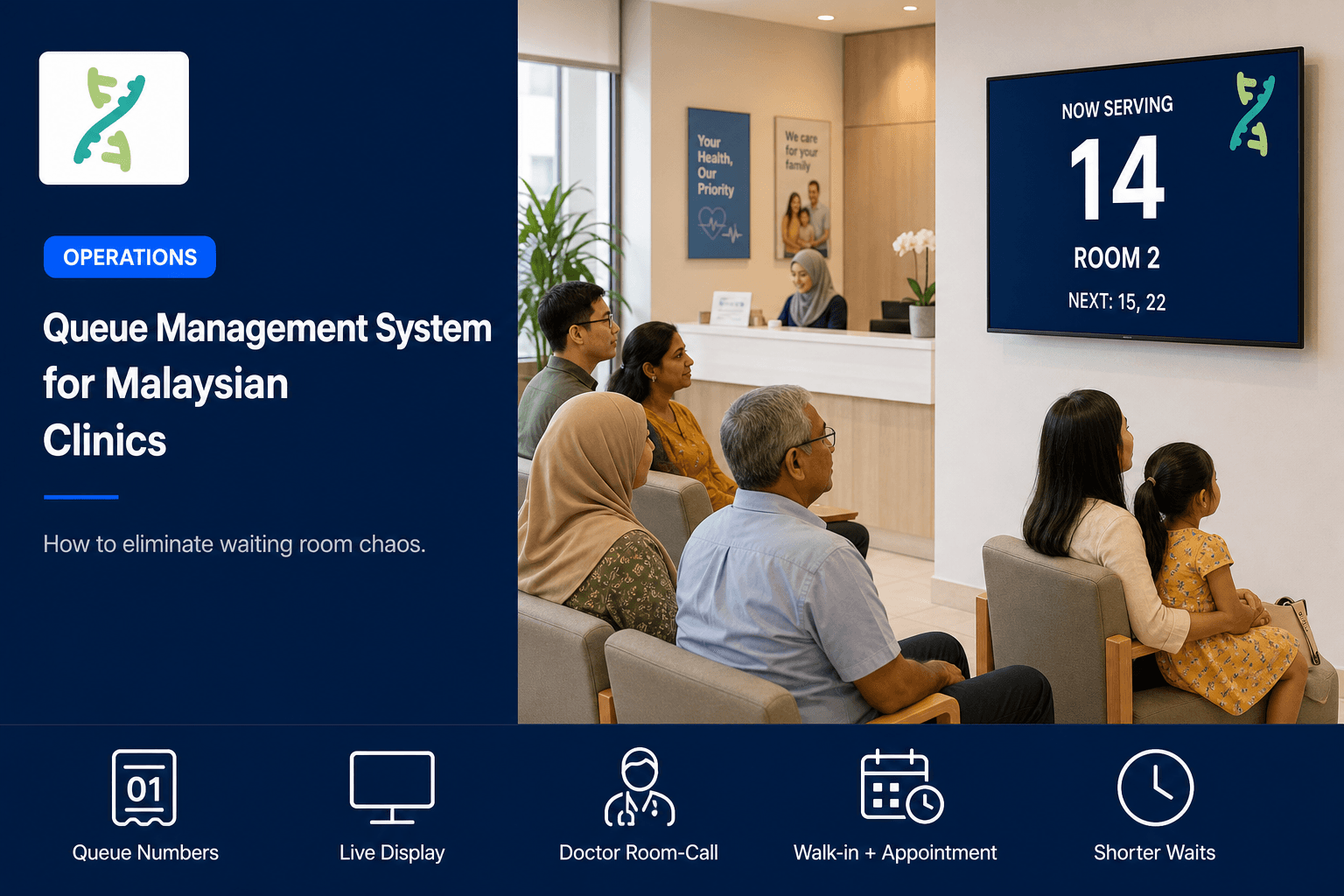
Queue Management System for Malaysian Clinics: How to Eliminate Waiting Room Chaos
TL;DR: The chaos in most clinic waiting rooms is not caused by patient volume — it is caused by the absence of a queue system. A digital clinic queue management system in Malaysia gives patients a number, shows them their position in real time, and lets doctors call patients into rooms from their workstation. The result is a calmer waiting room, fewer front-desk interruptions, and a measurably better patient experience.
Last reviewed: August 2026
Table of Contents
- Why Your Waiting Room Feels Chaotic Even on Normal Days
- What Patients Actually Experience Without a Queue System
- What a Clinic Queue Management System in Malaysia Does
- Walk-Ins vs Scheduled Appointments: Managing Both in One Queue
- How EazyClinic's Queue Management System Works
- Queue System Readiness Checklist
- FAQ
Why Your Waiting Room Feels Chaotic Even on Normal Days
Walk into a busy Malaysian clinic at 10am and observe what happens when a patient finishes registering. The receptionist writes their name on a paper list or calls it out verbally. The patient sits down in the waiting area. At some point — nobody is sure when — a nurse or doctor calls the name from the hallway. If the patient did not hear, they miss their turn. If the waiting room is noisy, three people think their name was called.
This scenario plays out dozens of times daily in clinics across Malaysia. The problem is not the volume of patients — it is the absence of a system. When queue management relies on verbal name-calling and manual tracking, every variable — a noisy waiting room, a patient who stepped away for a moment, a receptionist handling a phone call — becomes a source of chaos.
A digital clinic queue management system in Malaysia replaces all of this with a structured, visible, and auditable process that does not depend on anyone shouting across a waiting room.
"Patients used to walk out after 20 minutes if they had no idea where they were in the queue. After we installed a queue display screen, walkouts dropped immediately."
— Nurse Aini, Urban Health Clinic, Kuala Lumpur
What Patients Actually Experience Without a Queue System
From the patient's perspective, the absence of a queue system creates a specific type of anxiety: not knowing how long they will wait. This is not the same as waiting — it is uncertainty about waiting.
Research in healthcare service design consistently shows that perceived wait time is more impactful than actual wait time. A patient who waits 20 minutes knowing they are third in the queue has a significantly better experience than a patient who waits 15 minutes with no visibility into their position. The anxiety of not knowing when their turn will come makes the shorter wait feel longer.
This effect directly influences whether a patient returns to your clinic. A 2023 Accenture Health study found that 41% of patients who changed clinics cited poor waiting room experience — not clinical quality — as the primary reason. The clinical care may be excellent. If the waiting experience is chaotic and opaque, patients leave and do not come back.
What a Clinic Queue Management System in Malaysia Does
A digital clinic queue management system replaces verbal and manual queue management with a structured digital flow:
Queue number issuance. When a patient registers, they receive a queue number — either printed on a slip or displayed on a screen. This number is their position in the system. They know where they stand from the moment they check in.
Real-time display. A screen in the waiting area shows which queue numbers are currently being served, which are next, and which room to proceed to. Patients can watch their position approach without asking the front desk.
Doctor-initiated room call. When a doctor is ready for the next patient, they call the queue number from their workstation — not by walking to the door or asking a nurse to relay the message. The call appears on the waiting room display and can include an audio alert.
Walk-in and appointment queue integration. Scheduled appointment patients and walk-in patients are managed in the same queue with configurable priority rules — ensuring appointment patients are seen within their scheduled window while walk-ins are accommodated without creating a separate, unmanaged process.
Walk-Ins vs Scheduled Appointments: Managing Both in One Queue
The most common queue management challenge in Malaysian GP clinics is balancing scheduled appointments with the walk-in patients that form a significant portion of daily visits. Handled poorly, walk-ins disrupt the appointment schedule; managed too rigidly, walk-ins face unacceptably long waits and leave.
A well-designed clinic queue management system handles this with configurable priority rules:
- Scheduled appointment patients are assigned a priority queue position at their scheduled time
- Walk-in patients are assigned queue numbers that fill the gaps between scheduled slots
- If a scheduled patient is late, their slot is held for a defined period before the next walk-in is advanced
- The doctor sees real-time queue status and can make manual priority adjustments when clinically necessary
This approach keeps the appointment schedule largely intact while giving walk-in patients a predictable, visible wait — the combination that makes a clinic feel well-run from both the patient and staff perspective.
How EazyClinic's Queue Management System Works
EazyClinic's Queue Management module — launching soon — is designed for Malaysian clinic layouts, from single-doctor GP clinics to multi-room specialist practices.
Setup requires no additional hardware beyond a display screen. The queue display runs on a standard TV or monitor connected to the clinic's network — no proprietary hardware, no specialist installation.
Patient flow is fully digital. Queue numbers are issued at registration, visible on the display, and called by doctors from their consultation room interface. Front-desk involvement in the queue process reduces to registration only.
Walk-in and appointment integration is built in. Queue positions for scheduled patients are pre-loaded based on the day's appointment calendar. Walk-in numbers are inserted into the flow automatically based on configured priority rules.
For multi-room clinics, each consultation room appears as a separate channel on the display board. Patients see their queue number, which room they are called to, and the current status of all rooms — reducing the questions staff receive about where to go and how long to wait.
Manage your queue with EazyClinic — join the early access list and be among the first Malaysian clinics to roll out a digital queue system without proprietary hardware.
Queue System Readiness Checklist
- Display screen identified for waiting room installation (standard TV or monitor)
- Network connectivity confirmed in waiting room display location
- Queue priority rules defined for scheduled vs. walk-in patients
- Doctor room-call workflow tested from consultation workstation
- Reception team briefed on queue number issuance process
- Patient communication updated to mention queue system (signage, booking confirmation)
- Feedback mechanism in place to monitor patient experience post-launch
FAQ
How much specialist hardware does a clinic queue management system require?
EazyClinic's queue management system requires no proprietary hardware. The patient display runs on any standard TV or monitor connected to your clinic's network. Queue number issuance is handled through the existing reception workstation. There is no dedicated hardware purchase beyond the display screen.
Can patients see their queue position on their phone?
Queue position visibility via mobile is on EazyClinic's product roadmap. The initial release provides waiting room display visibility. Mobile queue tracking will allow patients to wait outside the clinic and return when their number approaches — a particularly useful feature for busy urban clinics with limited waiting room space.
How does a digital queue system help with PDPA compliance?
Digital queue systems eliminate the common practice of calling patient names loudly across a waiting room — a practice that inadvertently discloses that a named individual is a patient of the clinic. Queue numbers replace names in all public-facing display, reducing incidental disclosure of health-seeking behaviour.
Is the queue system suitable for specialist clinics with appointment-only models?
Yes, and it is particularly valuable in this context. Specialist clinics with long consultation times benefit from the clear visibility a queue system provides — patients know their position is stable and their wait is predictable, reducing anxiety during what are often high-stakes medical visits.
Give Patients the One Thing They Want Most: Knowing When Their Turn Is
The most common complaint about clinic visits in Malaysia is not the wait itself — it is not knowing how long the wait will be. A clinic queue management system in Malaysia solves this with technology that costs less than one frustrated patient walking out the door.
Manage your queue with EazyClinic and transform your waiting room from a source of patient frustration into a sign of a well-run clinic.
Sources: Accenture Health Consumer Survey (2023); Journal of Healthcare Management — Patient Wait Time Perception Study (2022); Malaysian Ministry of Health private clinic operational standards.
