



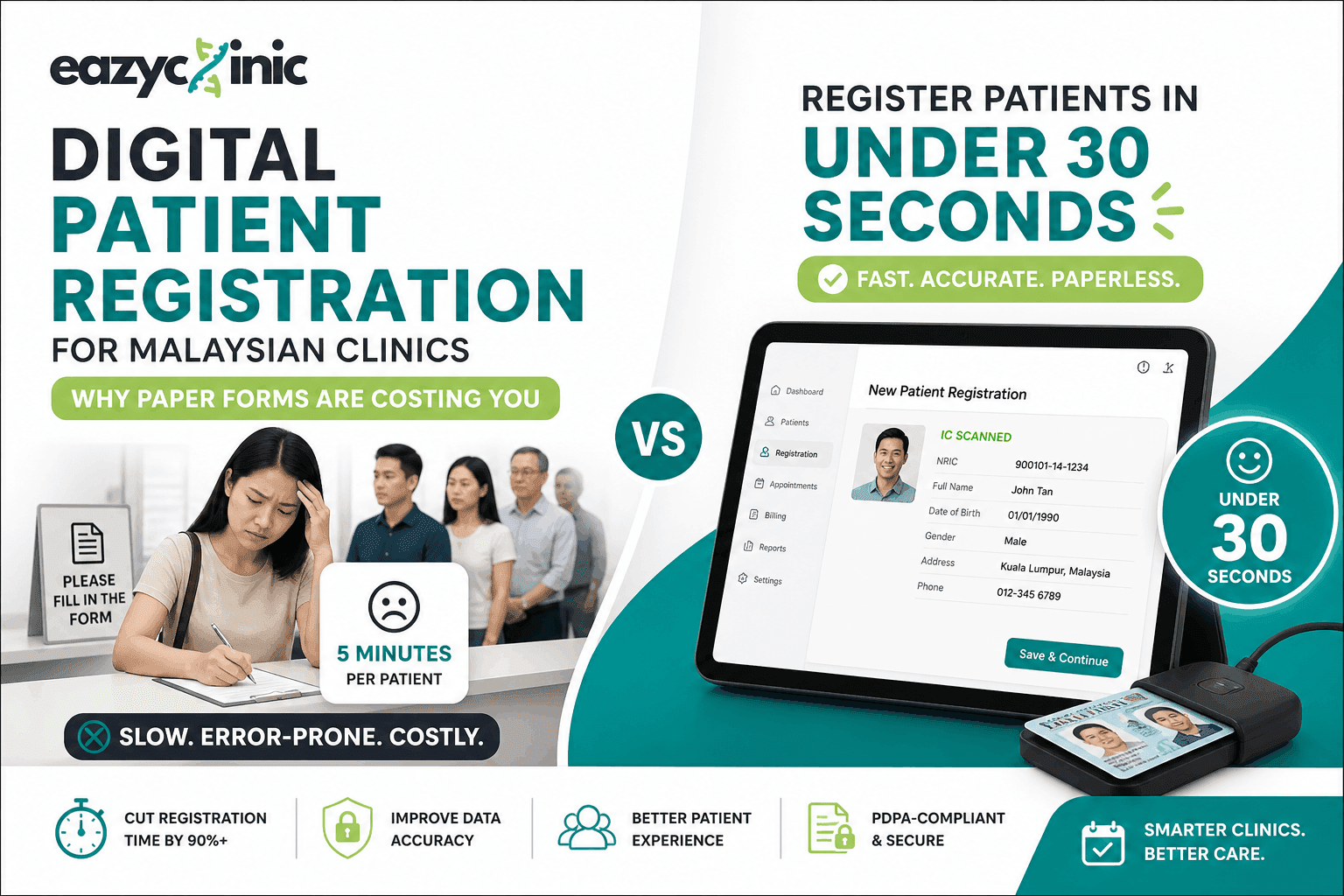
Digital Patient Registration for Malaysian Clinics: Why Paper Forms Are Costing You
TL;DR: Paper-based patient registration is the single biggest bottleneck at most Malaysian clinic front desks. It creates queues, introduces errors, and leaves a poor first impression. Digital patient registration using IC scanning and OCR cuts intake time from 5 minutes to under 30 seconds — and the impact on patient satisfaction is immediate.
Last reviewed: May 2026
Table of Contents
- The True Cost of Paper Registration at Your Clinic
- Why Patients Leave Before They Are Even Seen
- What Digital Patient Registration Actually Involves
- IC Scanning and OCR: How They Work in a Clinic Setting
- How Digital Patient Registration Malaysia Clinics Use Improves the Full Visit
- Digital Registration Readiness Checklist
- FAQ
What Is the True Cost of Paper Registration at a Malaysian Clinic?
Walk into most private clinics in Malaysia and you will see the same scene: a patient at the counter filling out a form by hand while a queue builds behind them. It looks manageable. The real cost is hidden.
A single paper registration takes between 3 and 7 minutes — form completion, front-desk data entry into the system, verification, and filing. For a clinic seeing 60 patients a day, that is between 3 and 7 hours of front-desk time consumed entirely by data entry. That is before a single phone call is answered or a single walk-in is handled.
The financial cost compounds further: paper forms must be stored, retrieved, and eventually disposed of in compliance with PDPA requirements. Storage space, filing labour, and paper costs add up to thousands of ringgit annually for a mid-sized clinic — money spent producing zero clinical value.
"IC scanning cut our registration time from about 4 minutes to under a minute. Patients regularly comment on how smooth the check-in process feels now."
— Nurse Hamidah, Klinik Medic Family, Shah Alam
Why Patients Leave Before They Are Even Seen
Waiting is the number one reason patients switch clinics. A 2022 patient experience survey by Frost & Sullivan found that 67% of Malaysian healthcare patients cited long wait times as their primary frustration with outpatient clinics. Registration queues are often the first — and most avoidable — source of that wait.
When a patient walks in and sees four people ahead of them at the counter, they make a quick calculation: is this worth my time? For follow-up visits or non-urgent consultations, many walk out. You never see them leave the system — they simply stop appearing on your schedule.
First impressions also carry disproportionate weight. A slow, paper-heavy registration process signals disorganisation regardless of how good the clinical care is. Patients who experience fast, professional check-in are measurably more likely to return and to refer others.
What Digital Patient Registration Actually Involves
Digital patient registration replaces the paper form with a combination of electronic data entry tools that speed up and automate the intake process. For Malaysian clinics, this typically means three components working together:
Electronic intake forms replace handwritten forms. Patient details — name, IC number, date of birth, contact number, address, allergies — are entered or captured digitally and flow directly into the patient record without a separate data entry step.
IC reader integration reads the patient's MyKad barcode or chip automatically, populating all identity fields in under five seconds. No typing. No transcription errors. The patient hands over their IC, the system does the rest.
OCR (Optical Character Recognition) captures data from images — useful for walk-in patients without an appointment, referral letters with patient details, or older IC formats not supported by chip readers.
IC Scanning and OCR: How They Work in a Clinic Setting
IC Reader Integration
A hardware IC reader connects to the clinic workstation and reads the patient's MyKad instantly. The data — NRIC number, full name, date of birth, gender, and address — transfers directly into the clinic management system. For returning patients, the system matches the IC number to the existing record, loading their full history with no manual search.
For new patients, a profile is created automatically using the captured data, with only a contact number and allergy history needed from the patient verbally. Registration that once took 5 minutes now takes under 30 seconds.
OCR Capture
Where an IC reader is not available or a patient presents a document rather than their MyKad, OCR captures identity data from a photo taken with a connected camera or scanner. The technology is particularly useful in high-volume clinics where patients sometimes arrive with referral letters or insurance cards that contain pre-filled demographics.
How Digital Patient Registration Malaysia Clinics Use Improves the Full Visit
Digital patient registration for Malaysian clinics does more than speed up the front desk. When patient data is captured accurately at intake, every downstream step benefits.
Consultations are better prepared. When a patient reaches the doctor's room, their record is already open, their history is visible, and their last visit notes are on screen. The doctor does not start from scratch every time.
Billing is faster and more accurate. Because the patient profile is linked to the consultation record, billing pulls the correct patient name, IC number, and insurance panel automatically. Billing errors caused by misread handwriting disappear.
Compliance is simpler. PDPA-compliant data handling requires that patient records be stored securely and retrievably. Digital records in a cloud-based clinic management system are automatically encrypted, backed up, and accessible — unlike filing cabinets.
EazyClinic's patient registration module combines IC reader support, OCR-based capture, and digital intake forms into a single workflow. Go digital with EazyClinic registration and cut your front-desk workload from the very first day.
Digital Registration Readiness Checklist
- Current registration time per patient measured (target: under 60 seconds)
- IC reader hardware compatible with clinic workstations
- Clinic management system supports IC reader and OCR integration
- Patient data flows directly from registration into consultation records
- Returning patient records auto-load from IC scan without manual search
- Paper form storage and disposal process reviewed for PDPA compliance
- Front-desk staff trained on digital registration workflow
FAQ
How long does it take to set up digital patient registration at a clinic in Malaysia?
For clinics using EazyClinic, digital registration setup typically takes less than a day. IC reader hardware connects directly to the workstation, and the registration module is active immediately. Staff training takes around 30 minutes for most front-desk teams.
Does digital patient registration work for walk-in patients?
Yes. Walk-in patients are registered the same way as appointment patients — IC scan or manual entry for those without their MyKad. The digital registration system handles both simultaneously without separate queues or processes.
What happens to existing paper patient records?
Existing paper records do not need to be digitised all at once. Most clinics run a parallel process: returning patients are digitised at their next visit, while new patients are registered digitally from day one. Within 3–6 months, the majority of active patient records exist digitally.
Is digital patient registration compliant with PDPA Malaysia?
Yes, provided the clinic management system stores patient data on secure, encrypted infrastructure. EazyClinic's cloud-based system is hosted in Malaysia with role-based access controls and automatic backups — meeting PDPA requirements for secure personal data handling.
Can digital registration reduce errors in patient records?
Significantly. IC scanning eliminates transcription errors caused by illegible handwriting or manual data entry. In clinics that have switched from paper to digital registration, error rates in patient demographics drop to near zero within the first month.
Make Registration the Best Part of the Patient Visit
Your clinic's first 60 seconds with a patient sets the tone for everything that follows. Digital patient registration for Malaysian clinics is one of the fastest, most visible improvements you can make — patients notice it immediately, staff appreciate it from day one, and the data quality improvement pays dividends across every downstream process.
Go digital with EazyClinic registration and give your front desk the time back it deserves.
Sources: Frost & Sullivan Malaysia Healthcare Patient Experience Survey (2022); Personal Data Protection Act 2010 (Malaysia); National Registration Department MyKad specifications.
![[object Object] icon](/_next/static/media/whatsapp-logo.faecda2e.svg)